Fit the blade to the job
Scraperite blades combine a scraping style (edge geometry & coverage) with a material composition. Style controls access and control; composition controls pliability and chemical resistance. Use the Blade Selection Wizard to match composition to your surface and solvent.
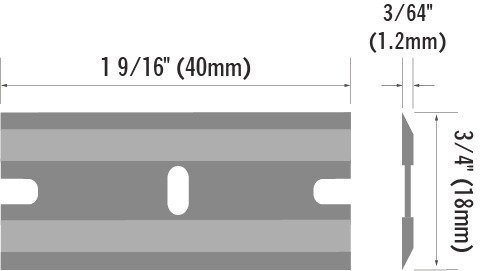
Standard Rectangle Blade
Our most popular style. Similar footprint to #9/#12 metal blades, but safer. Square corners give precise access into edges and tight corners.
- Right-angle corners for detail work and edge access.
- Great for stickers, paint flecks, labels, and tape residue.
- Works flat, concave, or convex surfaces with a shallow angle.
- Pair with the right composition for your surface & solvent.

Specialty Curved Blade
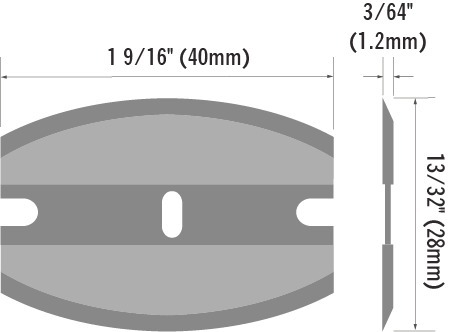
Curved profile improves control and reduces corner snagging on contoured or concave surfaces. Ideal when rotating action helps lift stickers up and away.
- Smooth ends for added safety (no sharp corners).
- More control at the scraping edge with arched geometry.
- Excellent on bumpers, body panels, and curved plastics.
- Choose composition by pliability and solvent resistance.

10 cm Wide Rectangle Blade
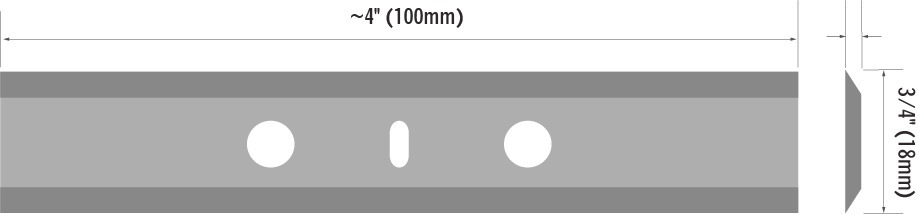
The widest blade in our line. Covers ~2.5× the area of a standard blade for faster progress on RVs, trucks, metal structures, and glass. Pairs well with the Tradesman Wide holder for added torque.
- 2.5× coverage for large, flat surfaces.
- Helps finish big jobs quickly and cleanly.
- Great on glass, metal, and gelcoat with the right composition.
- Use the Wizard to match surface & solvent.

Scraperite Blade Types & Characteristics
Safer scraping. Smarter materials. Proven performance.
Scraperite blades are engineered from advanced plastic composites—each designed for specific surface, substance, and solvent combinations. Explore the chemical resistance, edge hardness, and pliability of every Scraperite blade material to choose the safest and most effective option for your task. Whether you’re working with acrylic, paint, glass, gelcoat, or metal, our blades deliver controlled, scratch-free scraping without the risks of metal tools.
BLADE SELECTION = SUBSTANCE + SURFACE + SOLVENT
SOLVENT RESISTANCE
| Solvent | HYL | PRO | MBL | GPO | BIN |
|---|---|---|---|---|---|
| Acetone | |||||
| Isopropyl Alcohol (IPA) | |||||
| Ethanol / Denatured Alcohol | |||||
| Ammonia | |||||
| Bleach (Sodium Hypochlorite) | |||||
| Chlorine Bleach | |||||
| Citrus / d-Limonene | |||||
| Mineral Spirits | |||||
| Paint Thinner (aromatics) | |||||
| Xylene | |||||
| MEK | |||||
| Heptane | |||||
| Hexane | |||||
| Sodium Hydroxide (Lye) | |||||
| Sodium Metasilicate | |||||
| Muriatic Acid | |||||
| Oxalic Acid | |||||
| Hydrogen Peroxide | |||||
| Brake Cleaner | |||||
| Butyl Degreaser | |||||
| Enzyme Cleaner | |||||
| Lubricant Spray | |||||
| TSP | |||||
| Baking Soda + Water | |||||
| Dish Soap / Water | |||||
| White Vinegar | |||||
| Steam / Vapor |
Guidance reflects shop observations. Always test in a small, inconspicuous area and follow chemical safety/PPE.
SPECIFICATIONS
| Attribute | HYL | PRO | MBL | GPO | BIN |
|---|---|---|---|---|---|
| Edge Hardness | Hard | Med | Med | Med | Soft |
| Pliability — Scale of 1–10 (hardest) | 7 | 6 | 3 | 5 | 2 |
| Abrasiveness | High | Med | Med | Med | Low |
SURFACE TYPE
| Surface | HYL | PRO | MBL | GPO | BIN |
|---|---|---|---|---|---|
| Delicate Soft | |||||
| Uneven or Wavy | |||||
| Hard Flat | |||||
| Uneven or Rough Finish |
USE TEMP (°C/°F)
| Spec | HYL | PRO | MBL | GPO | BIN |
|---|---|---|---|---|---|
| MIN | -40 / -40 | -40 / -40 | -40 / -40 | -50 / -58 | -40 / -40 |
| MAX | 65 / 149 | 140 / 289 | 118 / 246 | 49 / 120 | 80 / 176 |
The Scraperite Advantage Why Material Matters
Scraperite invented the plastic razor blade, and for two decades, our expertise in material science has been the key to delivering safe, non-scratch scraping solutions for every job.
Unlike generic plastic scrapers that are simply stamped out of a single material, Scraperite blades are scientifically engineered. The difference in performance comes entirely from the plastic composition, not the shape of the edge.
Our proprietary formulations control two critical performance factors to ensure the right blade for the right task:
- Pliability / Ductility: This controls how the blade flexes and yields against your surface. A high-pliability blade conforms to curves and is gentler on delicate finishes (like our GPO Orange), while a tough, low-pliability blade delivers the targeted bite needed for stubborn, heavy-duty applications (like our PRO Magenta).
- Chemical Resistance: This determines which solvents the blade can safely tolerate without degrading, swelling, or losing performance. From common window cleaners (IPA / Alcohol) to industrial solvents (Acetone / MEK), our color-coded system ensures you select the correct material that will maintain its integrity and edge stability for a faster, cleaner job.
This attention to material detail is why technicians, detailers, and production teams worldwide trust Scraperite to deliver clean, controlled results without damage to surfaces or injury to hands. Use our material guide below to find the blade engineered for your specific challenge.
Blade Compositions — Comparison Grid
| Attribute | GPO | MBL | BIN | PRO | HYL |
|---|---|---|---|---|---|
| Pliability (Soft → Hard) | |||||
| Edge Hardness | Med | Med | Soft/Med | Med | Hard |
| Water / Soap | High | High | High | High | High |
| IPA (Alcohol) | High | High | High | High | High |
| Citrus / d-Limonene | High | Medium | High | High | High |
| Mineral Spirits | Medium | Low | High | Medium | High |
| Acetone | Low | Not rec. | Medium | Low | Medium |
| MEK | Not rec. | Not rec. | Low | Not rec. | Low |
| Best For (surfaces) | Auto paint, displays, cookware | Marine/Pool, curves, vinyl | Jan/San with stronger solvents | DIY/Trades, soft metals | Glass/tile (flat, hard) |
Guidance reflects shop observations. Always test in a small, inconspicuous area and follow chemical safety/PPE.
Quick answers about plastic razor blades
Which Scraperite blade is best for removing stickers and adhesive residue?
Use the Standard Rectangle blade: it is great for stickers, paint flecks, labels and tape residue. Then pick the material for your surface. Hard Yellow (HYL) is recommended for flat, hard surfaces such as glass and tile, and General Purpose Orange (GPO) for auto paint, displays and cookware. Always test in a small, inconspicuous area first.
Which blade can I use with acetone or MEK?
Acetone is hard on plastic. In our guidance Black Industrial (BIN) and Hard Yellow (HYL) tolerate acetone best (medium), GPO and PRO have low resistance and Medium Blue (MBL) is not recommended. For MEK, BIN and HYL have low resistance and GPO, MBL and PRO are not recommended. Follow chemical safety and PPE guidance and test first.
Which blades work with isopropyl alcohol (IPA) and window cleaner?
All five materials (GPO, MBL, PRO, BIN and HYL) have high resistance to isopropyl alcohol and to water and soap, so any of them works with common window cleaners.
What is the difference between blade style and blade material?
Style (edge geometry and coverage) controls access and control: standard rectangle, specialty curved or 10 cm wide. Composition (the plastic) controls pliability and chemical resistance. Choose the style for the shape of the job and the material for the surface and solvent.
Which blade is best for curved surfaces like bumpers and body panels?
The Specialty Curved blade. Its arched edge gives more control on contoured or concave surfaces and its smooth ends add safety. It is excellent on bumpers, body panels and curved plastics, and is available in GPO, MBL, PRO and BIN.
When should I use the widest blade?
The 10 cm (about 4 inch) wide rectangle blade covers about 2.5 times the area of a standard blade, so it finishes big jobs on RVs, trucks, metal structures and glass faster. It pairs well with the Tradesman Wide holder for added torque.
What temperatures can the blades handle?
Minimum use temperature is -40 C (-40 F) for HYL, PRO, MBL and BIN and -50 C (-58 F) for GPO. Maximum is 140 C (289 F) for PRO, 118 C (246 F) for MBL, 80 C (176 F) for BIN, 65 C (149 F) for HYL and 49 C (120 F) for GPO.